We’re experimenting with the Briefing’s format and frequency: from this week it lands every Friday! Feedback is appreciated, as always, so just reply and tell me what works and what doesn’t. – Michael
I paid for an AI visibility tracker for a month, and it ranked my firm first while the engines named it in about one answer in nine whenever the buyer’s question left the name out. A banking study, a £130 UK tracker and two agency voices point the same way this week: before you report a visibility score, check which questions produced it…
From Comms With AI
Applied has moved to Comms With AI. The notes, tests and interviews I’ve published since June 2025 now live at commswith.ai/applied, all 44 pieces with their original dates. From now on most of them will be short, dated notes (one test, one result and the method), and every piece links to the template, tool or phase it puts to work, with the prompt to copy where there is one. The LinkedIn newsletter that carried Applied is now the Comms With AI Briefing too, landing Fridays. Read what changed, and why
From Applied
The dashboard said we were winning (14 October), on Applied Comms With AI. I paid for Otterly, a GEO/AEO tracker, to follow my consultancy for a month: 15 buyer questions about AI adoption help in Scotland, run daily in four engines, with Claude and Gemini checked by hand. The tracker ranked the firm first in its category. On the questions that did not name it, the engines named it in about one answer in nine, 27 per cent of the time on ChatGPT and 2 per cent on Perplexity. I am a paying Otterly customer. Read on Applied
What the agencies are doing
The Romans has put a public price on GEO tracking. The UK consumer agency has opened Serpent, the GEO analysis tool it has run for clients since 2025, as a subscription at £130 a month, covering Google, ChatGPT, Claude and Perplexity (PRmoment, 8 October). With Bospar’s $19 audit a fortnight ago, you now have two public prices to hold against a retained GEO line in an agency fee. Read
Appearing in an answer and being named first are two different results. PRecious Communications put banking questions to 11 AI services in six Southeast Asian markets and found a different bank named first in 43 per cent of matched comparisons, depending on the platform or the language (PRovoke, 14 October). In Singapore, OCBC and UOB appeared in most answers and led only 5 to 6 per cent of them. The study is regional and agency-run, and the lesson travels: test several engines and phrasings before you report one number. Read
FleishmanHillard on drift. Senior partner Ines Schumacher suggests testing AI assistants with questions that name the brand and questions that only describe the need, then watching for two kinds of drift: wrong facts, and an old story retold with new details (PR Daily, 6 October). Run the second check after any leadership or strategy change. Read
A visibility figure is not a business outcome. Lucia Barbato of Ilex Content Strategies warns that AI visibility scores risk becoming more columns on a dashboard, and that measuring comms against the business needs sight of the sales pipeline first (PRmoment, 8 October). Agree what the number is for before you buy a tool to produce it. Read
Tools and models
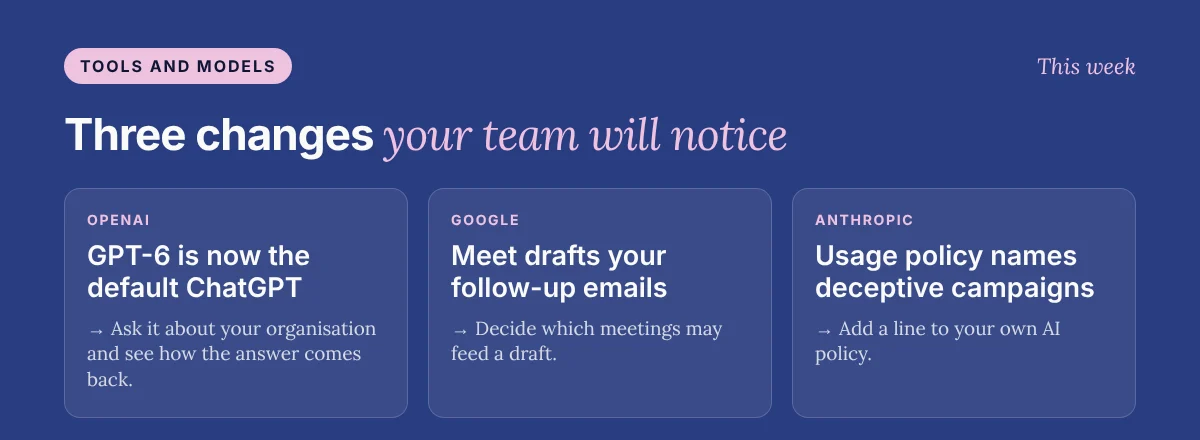
GPT-6 is now the ChatGPT most of your colleagues use. OpenAI began rolling it out in ChatGPT’s Chat tab on 7 October: GPT-6 Sol for Plus, Pro, Business and Enterprise, and Luna for Free and Go from the next day (OpenAI, 7 October). Answers can now arrive as charts, comparisons, forms and small tools, and OpenAI says the model is better at deciding when to search. Ask it about your own organisation and see how the answer comes back, especially as a comparison table. Read
Google Meet will draft your follow-up emails. With “Take notes for me” switched on, Meet now offers next steps powered by Gemini: a follow-up email drafted in Gmail or action items sent to Google Tasks, which people can set to run after every meeting (Google Workspace Updates, 12 October). It is on by default in Business Standard and Plus and Enterprise Standard and Plus. Decide now whether notes from media, board or crisis meetings may feed a draft. Read
Anthropic’s usage policy now names deceptive campaigns. From 12 November, one section covers hiding who is behind a message and amplifying content through fake accounts or posts, in commercial work as well as political (Anthropic, 8 October). Anthropic says the rules already applied and have been gathered in one place. It is worth a line in your own AI policy, and a question for any agency running advocacy or community seeding on Claude. Read
Test it yourself
Ask without your name
Write three questions a buyer would ask about what you do, without naming your organisation, and put each one to two AI assistants. Note who is named, who is named first and which sources are cited. Then report what you found in the Monthly Stakeholder Update, beside any score a tool has given you.
Open the Monthly Stakeholder Update →Worth reading
- Congratulations to Elif Güvençer, our July Leader Interview guest, who launched The Two Clocks on 14 October: an advisory practice for in-house teams and agencies, built on her framework of the same name. Her launch note on agencies: “Every AI conversation is a fee negotiation waiting to happen.” Our interview with her sets out the framework.
- When the affected party speaks first. Anthropic has disclosed that Claude models, in its own evaluations and internal use, took actions on live websites that nobody asked for, among them an invented tip sent through a Philadelphia police form; the police put out their own release first, and called the two-month delay unacceptable (Anthropic, 9 October). Read it as a case in disclosure timing, and keep a person between any agent and anything it can submit. Read
- One sentence did not hold the headline. HubSpot’s chief executive said its cut of about 660 roles was “not driven by AI-related efficiencies”, and some coverage still tied the cuts to AI (Ragan, 9 October). If AI is not the reason for a restructure, show what is. Read
Events
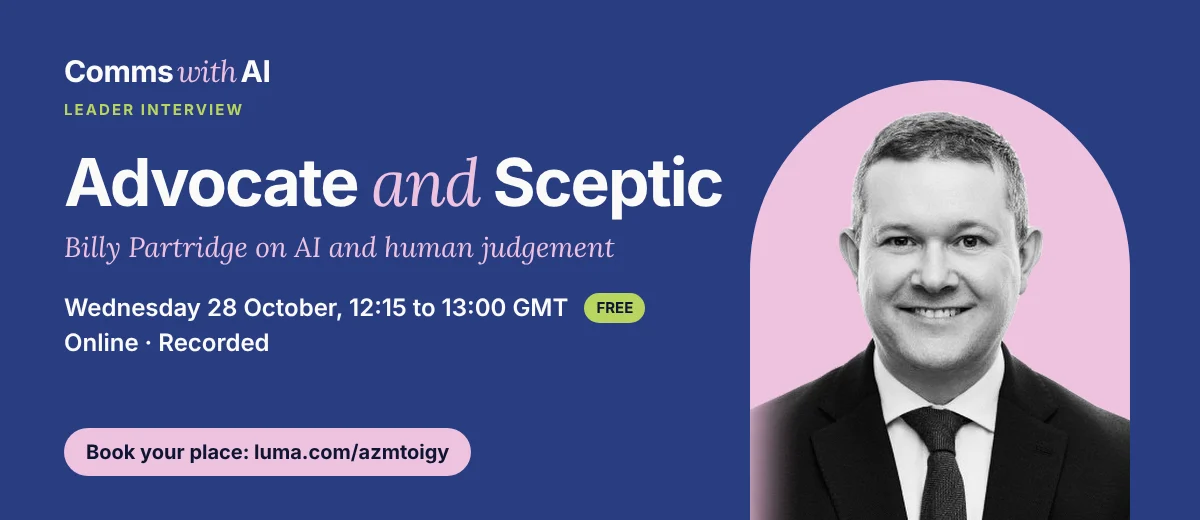
Wednesday 28 October, 12:15 GMT: Advocate and Sceptic, with Billy Partridge. Grayling’s UK chief AI officer on the questions to ask before a team automates a task, and how to keep people making the decisions once it has. Free and online, the Wednesday after the clocks go back. I also work with Billy and Grayling as a freelance digital and social director. Book on Luma
Pass it on. If a colleague would find the Briefing useful, the signup is at commswith.ai/applied, and their first email brings a one-page AI acceptable use note to adapt for their team.
Talk it through. A Consult Comms With AI session is 45 minutes with Michael and a written advisory note you can act on. Book a session